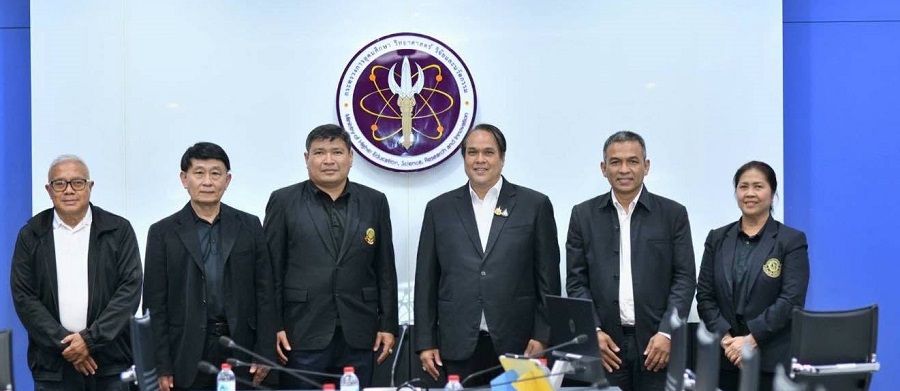
During the meeting, Assoc. Prof. Dr. Sakar Thichantuk, Director of the Center, and Assoc. Prof. Dr. Nikom Laemsak, Advisor to the Center, discussed the approach to driving the "72nd Birthday Anniversary Commemorative Herbal Botanical Garden Project for Her Royal Highness Princess Maha Chakri Sirindhorn" to promote the utilization of herbal resources and biodiversity for sustainable national development.
The project aims to develop food and nutritional security, leading to the development of dietary supplements. (Nutraceuticals), nutritional medicine, foods containing bioactive compounds, and high-value active compounds, coupled with the promotion of smart organic agriculture that applies biotechnology and innovation to address climate change, as well as knowledge transfer to small-scale farmers, the creation of collaborative networks, and support for operations under the Royal Project for Plant Genetic Conservation.
During this discussion, executives from the Ministry of Higher Education, Science, Research and Innovation (MHESI) suggested that the executives of the Sirindhorn Center for Sustainable Development, Kasetsart University, focus on driving policies related to poverty alleviation and the pursuit of carbon neutrality (Net Zero), in accordance with the policies of Professor Dr. Yoschanan Wongsawat, Deputy Prime Minister and Minister of MHESI. This would serve as a mechanism for integrating data, monitoring results, and systematically driving projects, ultimately leading to improved quality of life for farmers, the conservation of natural resources, and the sustainable development of the country's bioeconomy.
 |
 |
 |
 |